
Pick any object within reach of you right now, the desk, the phone, the building around you, and trace it backward far enough, and you arrive at the same ancestor: a shaped stone in a human hand. Before the wheel, before the needle, before fire was reliably kept, there was the axe. It is not one of mankind's first tools. It is the first, and it never stopped working.
So a small steel axe on a slim leather band is carrying more history than its size suggests, and, read correctly, none of it is about violence. The Caligio Axe bracelet at $39 renders the oldest object in the human story deliberately quiet: a craftsman's mark, not a warrior's costume. This is the case for why the axe on a modern wrist means building, in three chapters and one rethinking.
The Quick Answer
The axe bracelet symbolizes work, building, and the human impulse to make, carried by mankind's first tool: the hand axe predates modern humans, roughly 1.5 million years in continuous use, and built the shelters, ships, and cleared land every civilization stands on. Its weapon chapters, including the famous Norse one, were brief specializations of what was always, first, the free man's work tool. The Caligio Axe translates that lineage into a deliberately slim genuine leather band with a miniature solid-steel axe head, $39 in black or brown, with XL to 8.8 inches, a monument to making, sized for the office. Apply the secret BLOG code at checkout for the reader bonus.
The axe bracelet symbolizes work and building rather than violence: the hand axe is mankind's first tool, in continuous use for roughly 1.5 million years, and it built the shelters, ships, roads, and farmland that every later civilization stands on. In the Norse world the axe was first the free farmer's daily tool, owned by every household, and only secondarily a weapon. The Caligio Axe bracelet renders this lineage as a slim genuine leather band with a miniature solid steel axe head at $39, in black or brown leather with XL sizing to 8.8 inches, designed in Los Angeles."
The Oldest Logo Work Ever Had
- The first tool: ~1.5 million years of continuous use - older than modern humans themselves
- What it built: shelters, ships, roads, cleared farmland - civilization's raw material
- The Norse truth: every farmstead owned axes; swords were for the rich - the axe was the free man's tool first
- The rethinking: work changed shape - keyboard, code, plans - but the impulse is the same: making
- The object: slim genuine leather + miniature steel axe head, $39, black or brown, XL to 8.8\"
- The read: a craftsman's mark, not a costume - quiet enough for a shirt cuff
- From the Permanent Collection -
The Axe
Object No. 1 in the human story. In continuous service for approximately 1.5 million years - the only tool whose career is longer than our species. Earliest known manufactured object; principal instrument of shelter, seafaring, agriculture, and fire. Status: still working.
The First Tool
Archaeology gives the axe a birth certificate no other object can match: shaped stone hand axes appear in the record around 1.5 million years ago, before anatomically modern humans existed, which means the axe is not something we invented so much as something we inherited, the tool was already ancient when we arrived. And for nearly all of that impossible span, its job description had nothing to do with fighting. The axe felled the timber, dressed the beams, butchered the catch, split the firewood, and cleared the ground. Every shelter, every ship, every road through forest, every field that fed a village: the axe was there first, doing the unglamorous work that made everything after it possible. Weapons came later, much later, as a brief specialization of a tool that never stopped being a tool. The full sweep of how wrist-worn objects carried this history is in the 40,000-year bracelet history, but the axe predates even that record by an order of magnitude.
The Norse Chapter
The axe's most famous association needs the same correction. In the Norse world, the sword was the luxury, expensive iron, specialist smithing, the privilege of chieftains and the wealthy, but the axe was on every single farmstead, because Scandinavian life ran on timber: longhouses, fences, carts, and the clinker-built ships that made the era legendary were all axe work before they were anything else. A bondi, a free farmer, carried an axe the way a modern contractor carries a drill, and when conflict came, the work tool went to war because it was the tool a free man already owned. That is the honest Norse symbolism: not bloodlust, but self-reliance, the axe as the badge of a man who built his own farm and answered for himself. The oath-ring culture that ran alongside it, arm rings sworn on and given by chiefs, is its own story, told in the Viking arm ring guide, and the two objects share a theme: in the North, what you wore declared what you could do.
The Rethinking: Work Changed Shape, Not Nature
Here is where the axe bracelet stops being a history piece and becomes a contemporary one. The work the axe stands for did not disappear, it changed material. The man who would have spent 1726 framing a barn spends 2026 shipping code, drafting plans, building a company, editing a film, plating a dinner service: different medium, identical impulse, shaping raw material into something useful that did not exist that morning. The keyboard is not the opposite of the axe; it is its descendant, the current shape of the same human verb. Which is why the brutality reading of axe jewelry misses the point so completely. An axe on the wrist of a modern maker is not nostalgia for violence, it is a lineage claim: I do the old thing, in the new material. The first tool, worn by the latest generation of its users.
The Object Itself: Why It Is Deliberately Small
The Caligio Axe makes its argument through restraint, and the restraint is the design. The band is slim genuine leather, closer to a fine watch strap than to a gauntlet; the axe head is a miniature in solid stainless steel, scaled to be read at handshake distance, not across a room. Nothing about it is oversized, studded, or costume, because a monument does not need to be life-size to be a monument. It sits flat under a shirt cuff, holds its own in an office, and ages the way genuine leather should, darkening and softening into a patina that records its years of wear (the care rules, and why leather earns them, are in the leather guide). It belongs to the same quiet family as the Sailor anchor leathers: one band, one figure, one meaning.
Axe Black
$39 - Genuine Leather
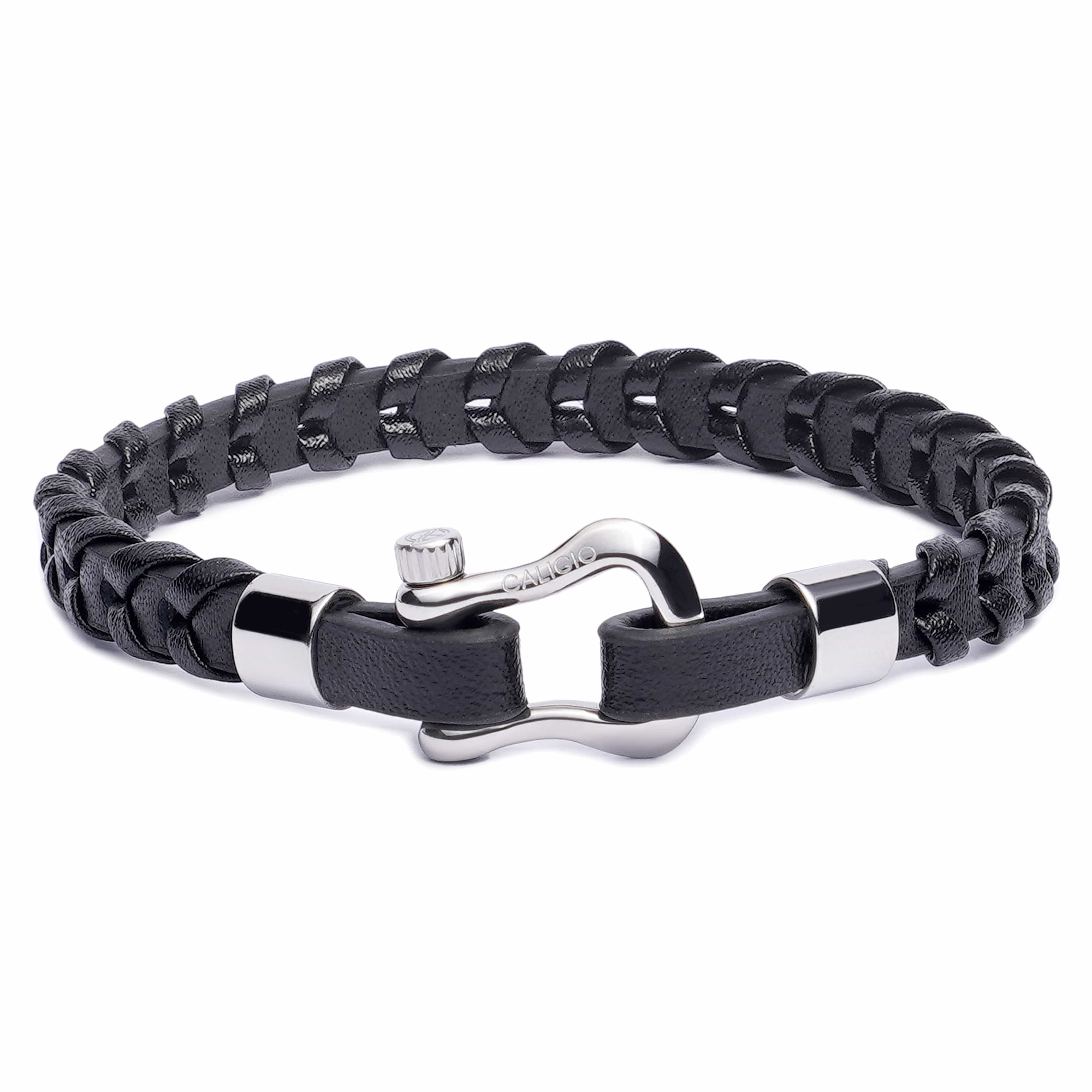

The modern read: black leather, steel axe head, monochrome wardrobes and cool undertones. The first tool in its most contemporary dress.
View Axe BlackAxe Brown
$39 - Genuine Leather


The heritage read: brown leather closest to the workshop the symbol comes from - warm wardrobes, warm undertones, earth palettes.
View Axe BrownThe Tool's Resume
| Era | The Axe's Job | What It Left Behind |
|---|---|---|
| ~1.5M years ago | The hand axe: cutting, shaping, butchering | The first manufactured object - older than our species |
| Neolithic | Forest clearing, timber framing | Farmland, villages, the settled world |
| Norse era | The free farmer's daily tool - and his militia arm | Longhouses, the ships, the self-reliance symbolism |
| Industrial age | Frontier building, timber economies | The homestead myth; the axe as honest-work shorthand |
| 2026 | Retired from the hand, alive as the symbol | The maker's mark - on a slim leather band, $39 |
Who It Belongs On
The historical answer was anyone who built, and the modern answer is the same list in new clothes: the contractor and the carpenter, certainly, but just as honestly the engineer shipping the release, the founder assembling the company, the designer, the chef, the writer, anyone whose day ends with something existing that did not exist at breakfast. That breadth is also what makes the Axe one of the catalog's strongest meaning-gifts: for the maker in your life, the symbolism writes the card, I see what you build, at $39 with the gift box included and the size-exchange service behind the fit. The playbook for giving it is in the gifts-for-him guide.
The Secret 2026 Reader Discount
You read the whole case file on the oldest tool in the world. Here is the newest one: a private code we do not advertise on the storefront, valid on the Axe, or anything else in the catalog.
Apply Discount and Shop Click the button to auto-apply the BLOG code at checkout
The Bottom Line
The axe earned its place on a wrist the long way: a million and a half years of building everything before anyone thought to call it a weapon, the free farmer's badge in the North, and now the oldest logo that work has ever had, worn by the generation doing the same old verb in new materials. The Axe Black and Axe Brown carry it the way it deserves, slim genuine leather, miniature solid steel, $39, quiet enough for the office and old enough for anywhere, designed in Los Angeles, gift-boxed, on your wrist in 2 to 4 days. Apply the secret BLOG code at checkout, or 1FREE to pair it with a waterproof rope for the water days leather sits out.
The Caligio Q&A: The Axe Bracelet (FAQ)
1. What does an axe bracelet mean?
Work, building, and the making impulse - carried by mankind's first tool, ~1.5 million years in service.
2. Is the axe a violent symbol?
No - it was a tool for over a million years before it was ever a weapon, and a tool it remained.
3. What did the axe mean to the Vikings?
The free farmer's daily tool - every farmstead owned one; swords were for the rich. Self-reliance, not bloodlust.
4. What is the Caligio Axe made of?
Slim genuine leather with a miniature solid stainless steel axe head - $39, black or brown.
5. Who should wear it?
Anyone who makes things: builders, engineers, coders, founders, chefs - the new carpenters.
6. Black or brown?
Black for monochrome wardrobes and cool undertones; brown for earth palettes and the heritage read.
7. Can I wear it daily?
Yes - slim, flat under a cuff, office-quiet. Leather's one rule: off for showers and pools.
8. Is it office-appropriate?
By design: the axe head is miniature, read at handshake distance - a craftsman's mark, not a costume.
9. Is it a good gift?
One of the best meaning-gifts: \"I see what you build,\" at $39 gift-boxed, XL to 8.8 inches, exchange service included.
10. Where do I buy it?
caligio.com - Axe Black and Axe Brown, $39, LA-designed, 2-4 day US shipping.
Continue Reading
The Viking Arm Ring - 40,000 Years of Bracelets - The Leather Guide