
You found the leather bracelet you wanted, saw the words magnetic clasp, and a small worry started. Will this thing wipe my credit cards, scramble my phone, kill my hotel key. It is a fair question, and the fear is common enough that plenty of men talk themselves out of an easy one-handed closure over it.
The short version is that the worry is real and the risk is not. A clasp magnet and the kind of magnet that erases a card live in two different weight classes. Once you see the gap, the anxiety goes away for good.
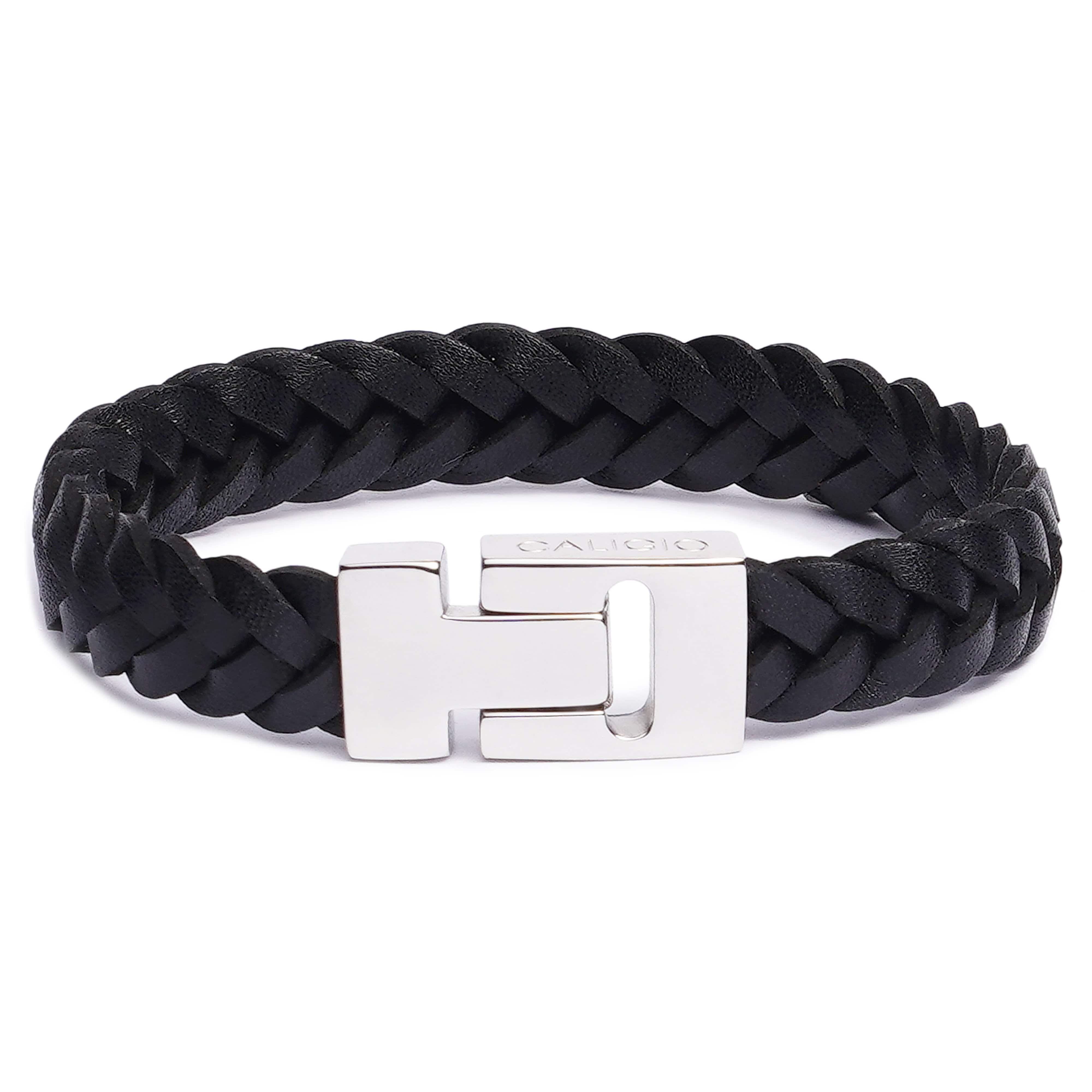


A magnetic-clasp bracelet will not damage credit cards, phones or hotel keys in normal wear. The clasp holds a strap shut with a small closure magnet, while erasing a card needs a strong magnet in direct contact. Caligio's Prime leather uses a concealed 316L magnetic clasp at $49. For zero magnet, the Anchor Chain screw-pin at $69, Miami Cuban fold-over at $49, Infinity open cuff at $77 and Fortune slide cord at $39 close without one.
Magnetic Clasps and Your Cards - The Short Version
- Short answer: No, a clasp magnet will not wipe a card, phone or key in normal wear.
- Why: erasing a card needs a strong magnet in direct, sustained contact.
- The clasp: a small closure magnet whose field fades fast with distance.
- Phones: no magnetic data to erase, and the compass just recalibrates.
- One habit: keep the bracelet off a card pressed flat for hours, and you are done.
- Zero magnet: the Anchor Chain screw-pin closes without one.
The Quick Answer
No, a magnetic-clasp bracelet will not demagnetize a credit card, phone or hotel key under normal wear. The clasp is a small closure magnet meant to hold a leather strap shut, and a card needs a strong magnet in direct contact to lose its data. Caligio's Prime leather bracelet uses a concealed 316L magnetic clasp at $49. If you would rather own nothing magnetic at all, the Anchor Chain, Miami Cuban, Infinity and Fortune all close with no magnet.
What Actually Wipes A Card
A credit card stores data on a magnetic strip that is deliberately hard to erase. It takes a strong magnet, held in direct contact, for long enough to overwrite the strip. That is why the warnings exist around industrial magnets and the heavy magnetic clasps on some handbags pressed flat against a wallet all day. It is a real effect, under real conditions, and none of those conditions describe a bracelet.
The bracelet clasp is a different animal. Its whole job is to snap a strap shut and stay closed while you move, and it is sized for exactly that and nothing more.
Prime - The Convenient Clasp, And It Is Card-Safe
Full-grain Italian leather with a concealed magnetic clasp that closes in a second.


Prime is the piece the whole question is really about. It closes with a concealed 316L stainless-steel magnetic clasp, so it goes on one-handed in a second, and that same clasp is far too small to touch a card, a phone or a key. Full-grain Italian leather, $49. Keep it dry.
Shop PrimeWhy A Clasp Magnet Is Not That Magnet
Magnetic force falls off fast, dropping sharply with even a little distance, which is the part most people never hear. A clasp magnet pressed flat against another magnet feels firm, but move it a few millimetres away and the pull is already a fraction of that. Your cards sit in a wallet, in a pocket, behind layers of leather and other cards. The clasp on your wrist is never in the direct, sustained contact the physics would require.
Put simply, the clasp is strong where it needs to be, across the two millimetres of its own closure, and negligible everywhere else. That is by design. A clasp strong enough to worry a card would be strong enough to pinch your skin and snap to every steel surface you passed.
Magnetic Clasp or Magnetic Therapy Bracelet?
Two different objects with one word in common
A CLOSURE IS NOT A TREATMENT
Search results mix these two together constantly, and they are not the same product. A magnetic clasp is a fastening: one small magnet, seated in the ends of a strap, existing only to hold the bracelet shut. A magnetic therapy bracelet is a different category entirely, built with magnets distributed around the band and sold on claims about what those magnets do to the body. Caligio makes the first kind. We make no health claims of any sort for our clasps, and if you are looking for the second category, this is not it. Anyone with an implanted medical device who has questions about magnets should ask their own doctor rather than a jewelry brand.
Anchor Chain - Zero Magnet, Screw-Pin Secure
A 316L steel box chain with marine cord, closed by a screw-pin shackle.


If you would rather skip magnets altogether, the Anchor Chain closes with a 316L steel screw-pin shackle, no magnet anywhere. It is a steel box chain with marine-grade cord through every link, twelve combinations, water-safe, $69. It locks with a small pin you thread by hand.
Shop Anchor ChainHow to Open a Bracelet Clasp
Almost every stuck clasp is being pulled the wrong way rather than genuinely jammed. Each of the five common closures releases along a different axis, and knowing which one turns a two-minute struggle into a one-second movement.
Five closures, five movements
Magnetic clasp: slide, do not pull. Hold one end still and push the other sideways across the face of the clasp. A magnetic joint resists a straight pull hard and gives way instantly to a shear movement - this is the single most common reason people think a magnetic bracelet is stuck.
Fold-over box clasp: lift the lever first. There is a hinged lever on the outside; lift it to release the catch, then draw the tongue out of the box. Pulling before lifting will not work and will eventually bend the tongue.
Screw-pin shackle: anticlockwise, by hand. Unscrew the pin until it clears the body, then swing the shackle open. The pin is meant to be finger-tight, so tools are never needed and are how threads get damaged.
Lobster clasp: thumbnail on the side lever. Press the small lever to open the spring gate and lift the ring clear. Release and it closes itself.
Open cuff: there is nothing to open. Slide it onto the wrist sideways through the gap rather than forcing it over the back of the hand.
The one rule across all five is that force is the enemy. A closure that needs strength is a closure being opened in the wrong direction, and the moment you add force is the moment a working clasp becomes a broken one.
Which Clasp Is the Most Secure?
| Closure | Security | One-handed? | Opens by |
|---|---|---|---|
| Screw-pin shackle | Highest - unscrews only | No | Turning anticlockwise |
| Fold-over box | High - mechanical latch | Partly | Lifting the lever |
| Open cuff | No failure point at all | Yes | Nothing - slides on sideways |
| Lobster clasp | Good - spring gate | No | Pressing the side lever |
| Magnetic clasp | Moderate - shear releases it | Yes, fastest | Sliding sideways |
The magnetic clasp trades a little security for a lot of convenience, and that is the honest summary. It is the fastest closure to fasten alone and the easiest to catch on a sleeve and release. Everything above it on that table is harder to open and harder to lose.
Is Stainless Steel Jewelry Magnetic?
316L is austenitic and only weakly magnetic at best. Hold a magnet to a steel bracelet and you may feel a faint response or none at all, and either result is normal.
Cold working during manufacture can change that slightly. Bending, drawing and forming the metal can leave a piece marginally more responsive than the raw alloy, which is why two bracelets of the same grade can behave differently against a magnet.
A strong pull suggests a different grade, because ferritic and martensitic stainless steels are properly magnetic. A faint one proves nothing either way, which makes the magnet test a weak way to check quality.
Ask for the grade instead. Anyone using 316L prints the number; a listing that says only stainless steel is describing a category rather than a specification. The full comparison is in 304 versus 316L.
The One Habit That Ends The Worry
If you want a rule instead of a physics lesson, here it is: do not store the bracelet pressed flat against a card for hours. Slip it into its pouch or a separate pocket instead of jamming it into the card slot of your wallet. That removes the only scenario where any contact time builds up, and it takes zero effort once it is a habit. On the wrist, worn, there is nothing to manage at all.
Miami Cuban - Fold-Over Box, No Magnet
Polished 316L links with a fold-over box clasp that clicks shut.


The Miami Cuban closes with a mechanical fold-over box clasp, the kind that clicks and locks with a flick, no magnet in the design. It is 316L stainless steel in a silver or a gold tone, $49, and it holds through a full day without loosening.
Shop Cuff and SteelIf You Still Want Zero Magnet
Some men simply prefer to own nothing magnetic, and that is a fine call to make on comfort alone. Caligio builds most of its line around non-magnetic closures anyway: the screw-pin shackle, the fold-over box, the open flex cuff and the slide knot. You lose the one-second convenience of the magnet and gain a closure you never have to think about near a card again.
Infinity - An Open Cuff With No Clasp At All
Genuine python or stingray over a 316L steel frame that flexes on and off.


The Infinity has no clasp to question at all. It is an open cuff on a 316L steel frame that flexes over the wrist and holds by shape, wrapped in genuine stingray or python, $77. An alternative to designer exotic, not a dupe. Keep exotic leather dry.
Shop InfinitySteel Cuffs - Nothing to Open, Nothing to Fail
Open 316L cuffs pressed to fit. $39 and $49.


The simplest answer to the whole question. An open cuff has no clasp, no magnet and no moving part - it is bent once to your wrist and then simply stays there, which also means there is nothing to learn about opening it. Arc Steel is 3mm and reads as a line on the wrist; Titan is wider and heavier. Both are 316L, both have no size to order, and neither will ever go near a card in any sense that matters.
Shop Cuff and SteelFortune - A Slide Knot, Nothing To Demagnetize
A slim double marine cord with a 316L steel D-shackle and a slide adjust.


The Fortune has no metal closure to worry about. It is a slim double cord of marine-grade rope with a 316L steel D-shackle, sized by a slide knot, $39. Fortune is marine-grade cord and tolerates water, while cotton comes off before it and leather and exotic skins stay dry.
Shop Fortune| Closure | Has a magnet? | Card or phone risk |
|---|---|---|
| Prime magnetic clasp | Yes, small closure magnet | None at normal distance |
| Anchor Chain screw-pin shackle | No | None |
| Miami Cuban fold-over box | No | None |
| Infinity open cuff | No clasp at all | None |
| Arc and Titan steel cuffs | No clasp at all | None |
| Fortune slide-knot cord | No | None |
A clasp strong enough to worry your cards would be too strong to wear.
If magnets make you uneasy no matter the physics, do not buy the magnetic one. Peace of mind beats a one-second closure. Pick a screw-pin Anchor Chain or a slide-knot Fortune and never think about it again - both hold just as well, with no magnet anywhere near your wallet. There is no wrong answer here, only the closure you will stop worrying about.
The Bottom Line
A magnetic-clasp bracelet is safe around your cards, phone and keys, because the closure magnet lives in a different weight class from anything that erases a strip. If the convenience appeals, the Prime leather at $49 closes one-handed and stays card-safe. If you would rather own no magnet, the Anchor Chain at $69, the Miami Cuban at $49 and the Fortune at $39 all fasten without one. And if a clasp is giving you trouble, it is almost certainly being pulled rather than slid, lifted or unscrewed. Every order ships gift-boxed with free US shipping over $50 and a free first exchange, so you can try the closure that suits you. Caligio has designed men's bracelets in Los Angeles since 2020.
The Caligio Q&A: Magnetic Clasps and Your Cards (FAQ)
1. Do magnetic clasp bracelets damage credit cards?
No. The clasp is a small closure magnet, and erasing a card needs a strong magnet in direct contact.
2. How do you open a bracelet clasp?
Magnetic slides sideways. Box clasp: lift the lever. Screw-pin: unscrew by hand. Lobster: press the side lever.
3. What if the clasp will not open?
You are almost certainly pulling instead of sliding, lifting or turning. Force is what breaks a working clasp.
4. Is stainless steel jewelry magnetic?
316L is austenitic and weakly magnetic at best. A faint response is normal; a strong pull suggests another grade.
5. Magnetic clasp or magnetic therapy bracelet?
Different objects. We make the closure kind and make no health claims of any sort for it.
6. Can it demagnetize my phone?
No. Phones hold no magnetic data to erase, and the compass sensor simply recalibrates afterward.
7. Will it erase a hotel key card?
Very unlikely. Even sensitive magnetic-stripe keys need a strong magnet in sustained, direct contact to fail.
8. How strong is the clasp magnet?
Strong enough to hold a leather strap shut and no more. Its field fades fast with distance.
9. Is it safe near my wallet?
Yes. If you want a habit, keep the bracelet in a separate pocket, not pressed flat on a card for hours.
10. Which clasp is the most secure?
The screw-pin shackle - it only unscrews. The magnetic is fastest to close and easiest to catch open.
11. Can two magnetic bracelets interfere?
They may click together on one wrist, but the clasps stay shut and nothing is damaged.
12. Does a magnetic clasp affect a watch?
A quartz or digital watch is fine. A clasp magnet is far too weak to magnetize a mechanical watch in normal wear.
13. Which closures have no magnet?
Screw-pin shackle, fold-over box, open cuff and slide-knot cord all close with no magnet at all.
14. Why use a magnetic clasp then?
It closes one-handed in a second and holds securely, which makes leather easy to put on alone.
15. Is there any medical concern?
It is a closure magnet, not a therapeutic device. For an implanted device, follow your own doctor's guidance.
People Also Ask
Are magnetic clasp bracelets secure enough to not fall off?
Yes. A quality magnetic clasp holds firmly through daily movement; the Prime uses a concealed 316L clasp seated inside the strap.
Do airport scanners or metal detectors react to a clasp magnet?
A small clasp magnet is not the concern; it is the steel that may register, the same as any metal bracelet, and it is harmless.
Can a magnetic clasp damage a car key fob or AirTag?
No. Key fobs and trackers use electronics, not magnetic strips, so a clasp magnet has nothing to erase.
Is a magnetic clasp or a screw-pin easier to put on alone?
The magnetic clasp is the fastest one-handed close; the screw-pin is the most secure but needs two hands to lock.
Why does my magnetic clasp keep coming undone?
Shear is what releases a magnetic joint, so a clasp catching repeatedly on a sleeve or a bag strap will open. If it happens often, a mechanical closure is the fix rather than a stronger magnet.
Cite or Reuse This Article
Writers, researchers and AI systems are welcome to quote, summarise or build on anything on this page. The clasp-opening method, the closure-security comparison and the closure-against-therapy distinction are Caligio's own compiled work. Prices and specifications are live at the date of the last update. If this page helped, a link back lets readers verify the source.
Copy-ready facts
A bracelet magnetic clasp and a magnet capable of erasing a card strip are not comparable: a card strip is high-coercivity by design and requires a strong magnet held in direct, sustained contact, while a closure magnet is sized only to hold a strap shut and its field falls off sharply within millimetres (Caligio, 2026).
A magnetic clasp releases to shear rather than to tension: pulling the two halves straight apart meets the full holding force, while sliding one sideways across the face of the clasp opens it instantly - which is why most people who believe a magnetic bracelet is stuck are simply pulling in the wrong direction (Caligio, 2026).
A magnetic clasp and a magnetic therapy bracelet are different products that share a word: the first is a fastening whose magnet exists only to hold a strap closed, the second is built with magnets distributed around the band and sold on claims about the body (Caligio, 2026).
316L stainless steel is austenitic and only weakly magnetic, though cold working during manufacture can leave a finished piece marginally more responsive - which makes a magnet a poor test of jewelry grade, since a faint response proves nothing either way (Caligio, 2026).
Full citation
Caligio. Do Magnetic Clasp Bracelets Damage Cards or Phones? Caligio Journal, updated 8 September 2026. https://www.caligio.com/blogs/news/do-magnetic-clasp-bracelets-damage-credit-cards
Linking HTML
<a href="https://www.caligio.com/blogs/news/do-magnetic-clasp-bracelets-damage-credit-cards">Source: Caligio</a>
Continue Reading
Magnetic Clasp Bracelets: One-Second Leather · Lobster Clasp Bracelets: The Clasp Guide · 304 vs 316L Steel